

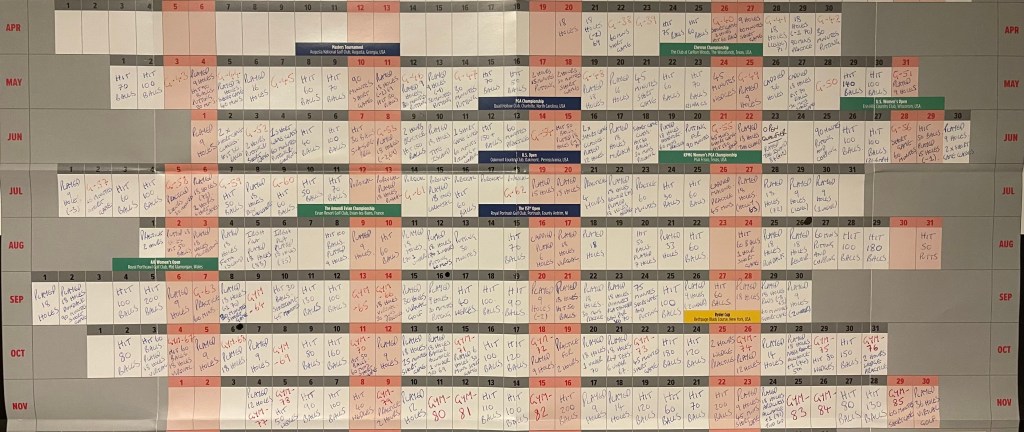
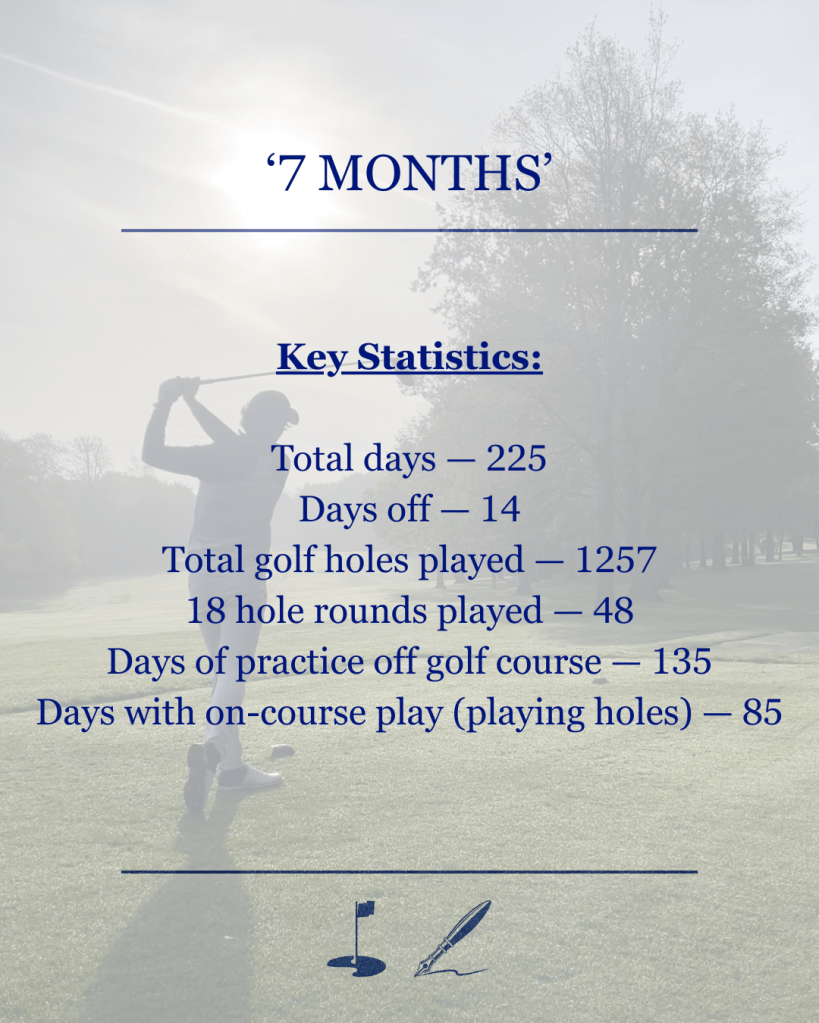
As many of you may know, I have recently kept a wall chart to keep a track of my daily practice habits. This was to keep me accountable; to provide evidence that I was ‘putting in the necessary work’; to use as research for my own golf and to apply to my coaching; and most importantly, to improve my golf. I have filled in my wall chart for over 7 months without fail. I recently crossed the 7-month mark at the end of November. I now feel like 7 months of solid work is a comprehensive enough ‘sample size’ and body of work, to draw some findings and conclusions. I have spent the last few weeks reflecting on the period of time, deciding on what I could pass onto others that might be in a similar position or just to those who want to get better.
It’s been challenging to narrow down my list of key findings, as I have learnt so much. The following 20 points are key factors and qualities that I feel are necessary to embark on the ‘journey to better’. Some people will agree with these, some people may disagree. These are simply my own personal views and findings. I’m not suggesting a person has to tick off all 20 points to make the most of their journey, but I certainly believe that most of these factors, qualities, characteristics, and ingredients have to align to truly start, stick with, and finish the journey. The more ambitious the goal or task, the more of these factors need to be in place.
Learning Points – part one of two.
1. Catalyst – Like the start of any great journey, it generally stems from a catalyst that made you take the first step. You need to find your ‘why’ in the first place. Why start anything in life? What’s your trigger or motivator? For me, it was hitting rock bottom with my golf one year ago. My standard of golf was directly affecting my enjoyment of the game. I had enough. I wanted to get better and back to playing the level of golf that I know I am capable of. To really buy into a journey or process, you are more likely to stick with the task if the catalyst comes from within. You shouldn’t need anyone else to prompt you. You should know what and when the catalyst is. It should hit you like a tonne of bricks and makes you think ‘enough is enough’. That is when you know it’s time to start the journey.
2. Purpose – What is the deeper purpose or meaning of your journey? To get better at a skill or craft? To get healthier or fitter? To meet new people? To make you feel better about yourself? To simply push yourself outside your comfort zone? This has to be decided by you. Find your reason. If you truly find out what this is, it will keep you on course for longer. You won’t quit, as you know this sense of purpose will keep you going, even on days that you might not want to. Your ‘purpose’ can be so individual to yourself, that no one else will ‘get it’, and that’s just fine.
3. Direction – With all journeys, we need direction. This might be for the day ahead; the week ahead; the month ahead; or even the year ahead. Direction fosters focus. Focus creates clarity. It’s also OK to admit you’ve gone the wrong direction at times. Sometimes we learn more from this. As long as you can realise you’re in the wrong direction, and quickly change course, you’ll be a step closer to your end destination. It’s also OK to ask for help with direction. Complex crafts like golf are extremely difficult to ‘figure out’ on your own. Find a mentor who has ‘been there, done that’. Ask a qualified professional/expert for guidance. And no, watching a YouTube video won’t provide the answers (for the most part).
4. Environment – Creating or finding an environment that will allow you to reach your goals is key. This can include the facilities you have access to or the people that surround you. Have people around you that support you; build you up; push you; want you to be better; and genuinely want you to succeed. Attract people with a similar mindset and goals. Toxic environments = toxic results. Don’t like your current environment? Then create or find a new one. If you radiate and exude the correct qualities, those who possess similar traits will find their way to you.
5. Flying solo – If you can’t find the correct people around you in life, then be prepared to ‘fly solo’. Even though it’s nice to complete a journey with others, it could be seen as even more rewarding to complete it solo. This shows courage, drive, and an unwavering commitment to your inner voice. Don’t wait for others in life. Take the first step, and go for it. You’ll regret waiting around for others. Do it for yourself, no one else.
6. Choices – You have to be cutthroat with your ‘choices’. Life is ultimately a cumulation of choices. Every choice you make has a knock-on effect on something in the future. Every choice you make must ultimately be aligned to your journey and purpose. These choices include how you use your time; who you spend your time with; and what you say ‘yes’ or ‘no’ to. Make the wrong choices and set yourself back. Make the correct choices, and you’ll probably end up where you want to. We’re all human, so no one knows for sure what the correct ‘choice’ is. All we can do is go with our brain; our gut; our heart; our experience; and our intuition. Align your priorities, and the correct choices should be obvious.
7. Discipline – Without discipline, no long-term commitment or journey is sustainable. Discipline is the glue that holds the journey together. It’s the key characteristic that fights off laziness, doubt, and temptation. You will have days when you don’t feel like doing the necessary work, but it’s these days that separate the best from the rest. At the beginning of any endeavour, you have to sign a theoretical contract with yourself. You’re making a deal to continue and show up, no matter what. ‘Excuses’ can’t be an option. Be brutal with consistency.
8. Effort and standards – Effort is the minimum requirement for accomplishing any task to a high level in life. Effort needs to be there every day, in everything you do. Half-ass something and you’ll be found out, maybe not today, but certainly down the line. I mean, why would you not put your best effort into something you care about? The main person you’re letting down is yourself. If you show effort to others, they will return the effort. Effort is contagious. Effort goes hand in hand with standards. Set yourself standards to uphold with everything you do. Expect the same standards from those around you. Demand more. As soon as you let your standards slip in anything in life, it can be the start of a downward spiral. You must take pride in everything you do.
9. Accountability and honesty – At times, there is no one watching. No one is there to judge you or check on you at all times. You have to remain accountable to yourself. Only you know if you’ve put full effort into a day or training session; only you know if you’ve completed your task for the day; only you know if you’ve got a bit better today. The best hold themselves accountable, to a standard that will allow them to reach their current ‘finish line’. If you can look into a mirror at the end of the day, knowing you’ve given it your all, you can sleep sound. Hold yourself accountable and take ownership. Accountability intertwines with honesty. Don’t lie to yourself or others, as you’re mainly hurting yourself.
10. Sacrifice – You will have to miss out on things in life. This might be a family event or a night out with friends. It’s impossible to do everything in life or keep everyone happy. You will have to stay true to yourself and, at times, be selfish. It’s OK to say no to people or requests (goes back to the ‘choices’ point). As long as the sacrifice is right for you, you will remain content. This leads back to your underlying purpose of the journey. Always put it first.
 Golf Thoughts