
As I continue to work on my own game throughout the current so-called ‘off-season months’, while also helping guide many others with their own golf games through this period of time, further reflection and thoughts result. A topic that has been on my mind for a few weeks is how to best use the limited time most have to work on their golf games, and how this practice time could be best served for golfers at various points of the learning and skill spectrum.
Most golfers, even if they do have time to practice, more than likely don’t know how this time should be best served in the quest for improvement. There are endless ways and types of practice. I don’t necessarily believe there is a ‘one size fits all’ prescription. Golfers, and humans, vary far too much in their personalities, learning styles, understanding, focus, and skill levels. What works for one, could be disastrous for another.
What makes the prescription for each golfer challenging, is that they are not only all of such varying skill levels, but even within those skill levels, each individual is at a very personal and specific point on their own ‘golf journey’ in time. For example, two golfers could be grouped into the same ‘skill level’, but depending on how their current performance and technique is, their prescription and homework could be drastically different. This is why generalisations of golf practice prescriptions do not work.
To provide some sort of starting point for a golfer, I’ve tried to create a graph that may be used as a framework for how practice time could or should be split up. The two forms of practice I have used in this scenario are ‘technique’ focused practice and ‘performance’ focused practice. The graph plots ‘technique’ practice against ‘performance’ practice as a percentage of available practice time.
I’ve plotted points on the graph which might be used as a starting point for each skill level, and furthermore, ‘technique’ versus ‘performance’ focus within that skill level. I’ve also highlighted regions of the graph for ‘off-season’, ‘in-season’, ‘swing changes’, and ‘competition prep’. The ‘skill levels’ are my modified version of the ‘Dreyfus Model of Skill Acquisition’, which I have tailored to golf.
As I’ve mentioned, this is simply a starting point. It’s up to a golfer to decide where they might fall on this graph, not only in terms of their skill level, but also in terms of what their golf game, in the present moment, may need. This graph is completely fluid, and all golfers may, and probably should, move around the graph throughout the course of a calendar year.
In the following paragraphs, I will provide my rationale for each point.
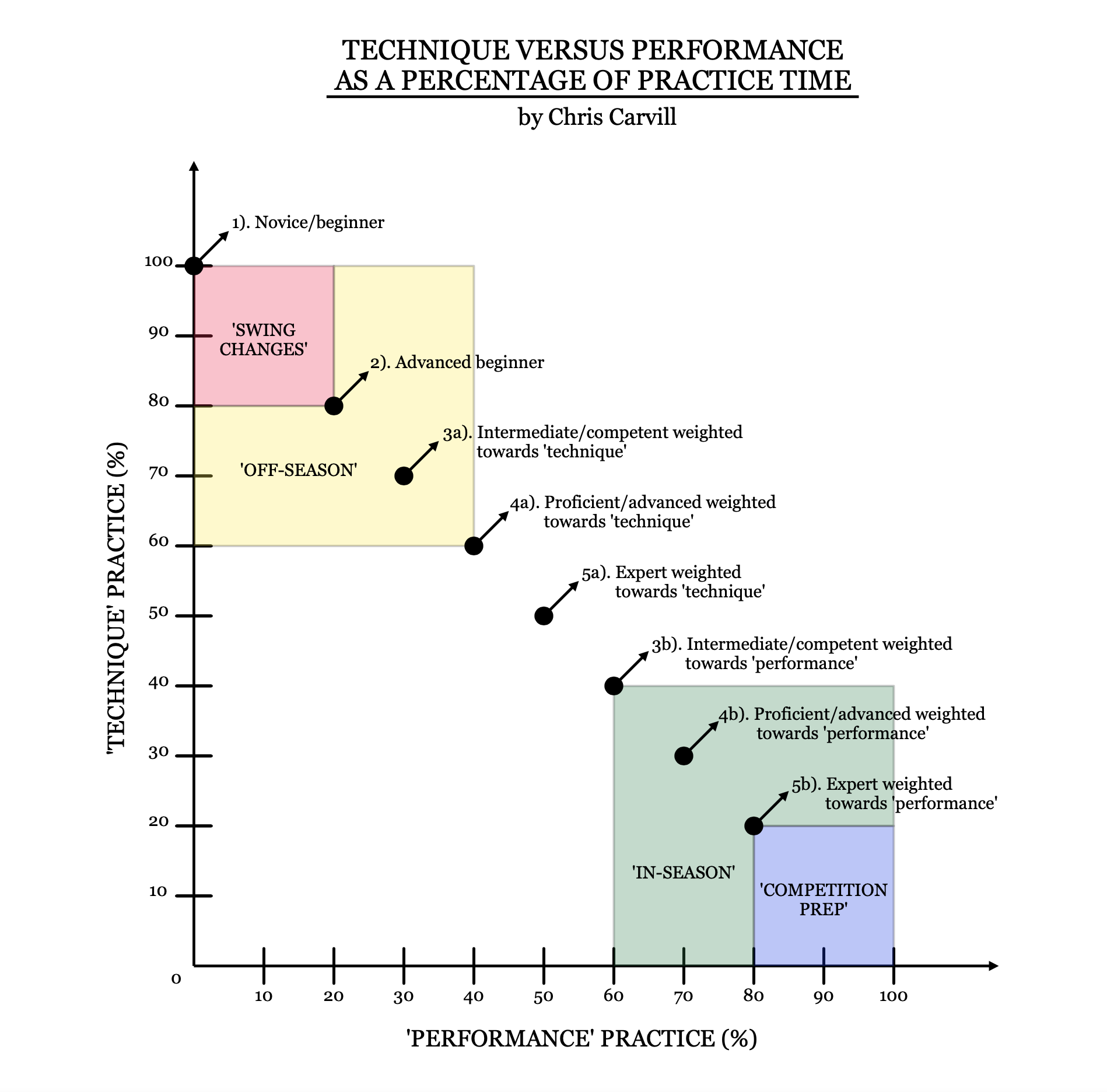
1). Novice/beginner — This is a person picking up a golf club for the very first time. They have no knowledge or understanding of the game. In this case, the golfer should be spending 100% of their practice time on ‘technique’ practice. Learning how to hold a golf club; set up to a golf ball; how to move the club and body throughout the swing; and basically, how to build a functional golf swing from scratch. There is zero need for ‘performance’ practice at this stage of the journey.
2). Advanced beginner — This is a person who has had a few range sessions and golf lessons. They may have been golfing between 6–12 months. They have a solid understanding of how to set up to a golf ball and swing a golf club. They are working their way towards playing on a golf course. 80% of practice should still be very ‘technique’ focused as bad habits still exist, and the golfer has to consciously work hard to carry out the movements in the desired manner. Performance work can start to be drip fed into practice sessions to advance knowledge of how to ‘play the game’.
3a). Intermediate/competent weighted towards ‘technique’— This person has been golfing for over 12 months, and they have played on a golf course a number of times. They have a sense of how to get around a golf course, but technically are lacking. To move onto the next level of golf, they need to improve technically, to have more control of the golf ball and reduce their ‘bad shots’. 70% of practice time should lean towards ‘technique’.
4a). Proficient/advanced weighted towards ‘technique’— This person has likely golfed for a number of years and is viewed as a good golfer, who understands the game to a high level. Their game holds up on different golf courses, and they feel like they can be ‘competitive’ at a club or local level. They, however, can’t reach an even higher level due to technical flaws in parts of their game. These limit the depth of their ‘shot armoury’, which is needed to reach ‘expert level’. 60% of practice is therefore ‘technique’ focused.
5a). Expert weighted towards ‘technique’— A person who has played for years and perfected most of their craft. Their golf ‘understanding and I.Q.’ is extremely high. They are competitive at a high level and have sampled ‘success’ in the game. However, like everyone, they are not immune to parts of their golf game technically drifting. They are either getting their game and swing back into their desired positions/slots, or are making a new technical change or upgrade in their game. 50% of their current practice is ‘technique’ practice.
3b). Intermediate/competent weighted towards ‘performance’— This person has been golfing for over 12 months, and they have played on a golf course a number of times. They have a decent sense of how to technically ‘swing a club’. Improvement is still needed in the ‘technical’ department of the game, but there is scope to add in ‘performance’ work. Topics such as course management and shot selection can be added into practice. 60% of practice time should lean towards ‘technique’, while 40% is ‘performance’.
4b). Proficient/advanced weighted towards ‘performance’— This person has likely golfed for a number of years and is viewed as a good golfer, who understands the game to a high level. Their game holds up on different golf courses, and they feel like they can be ‘competitive’ at a club or local level. The technical side of their golf game and swing is in a good place, but they lack the performance know-how in practice and on course. Advancements in strategy, thinking, and game management need made. 70% of practice is therefore ‘performance’ focused.
5b). Expert weighted towards ‘performance’— A person who has played for years and perfected most of their craft. Their golf ‘understanding and I.Q.’ is extremely high. They are competitive at a high level and have sampled ‘success’ in the game. ‘Technically’, their game and swing are in a very good place. The majority of their practice can be weighted towards ‘performance’ tasks such as tests, challenges, and tasks that advance their skill and provide evidence of advancement. 80% of their practice is weighted towards ‘performance’.
‘Swing Changes’— In this zone of the graph, ‘technique practice’ must take precedent. The main focus and goal is to improve or advance the golfers’ technique. ‘Performance’ shouldn’t be on the golfers’ radar. This takes place when changes are being made to the swing technique of the golfer. This could be minor swing changes or major swing changes.
‘Off-Season’— The ‘off-season’ could involve the ‘winter months’ or ‘non-competition months’, for example, the months of October to March. In this zone of the graph, ‘technique practice’ will form the majority of the golfers’ available practice time. Technique changes or advancements can be focused on, as perfect ‘performance’ is not a necessity during this period of time.
‘In-Season’— The ‘in-season’ could involve the ‘spring/summer months’ or ‘competition months’, for example, the months of April to September. In this zone of the graph, ‘performance practice’ will form the majority of the golfers’ available practice time. The golfer now cares more about how they ‘perform’, so practice can be tailored around ‘performance tasks’.
‘Competition Prep’— In this zone of the graph, ‘performance practice’ must take precedent. The main focus and goal is to compete and perform in the competition. Some minor ‘technique practice’ can be carried out, but more as part of a ‘swing maintenance program’. This is a time to sharpen skill, strategy, thinking, and execution.
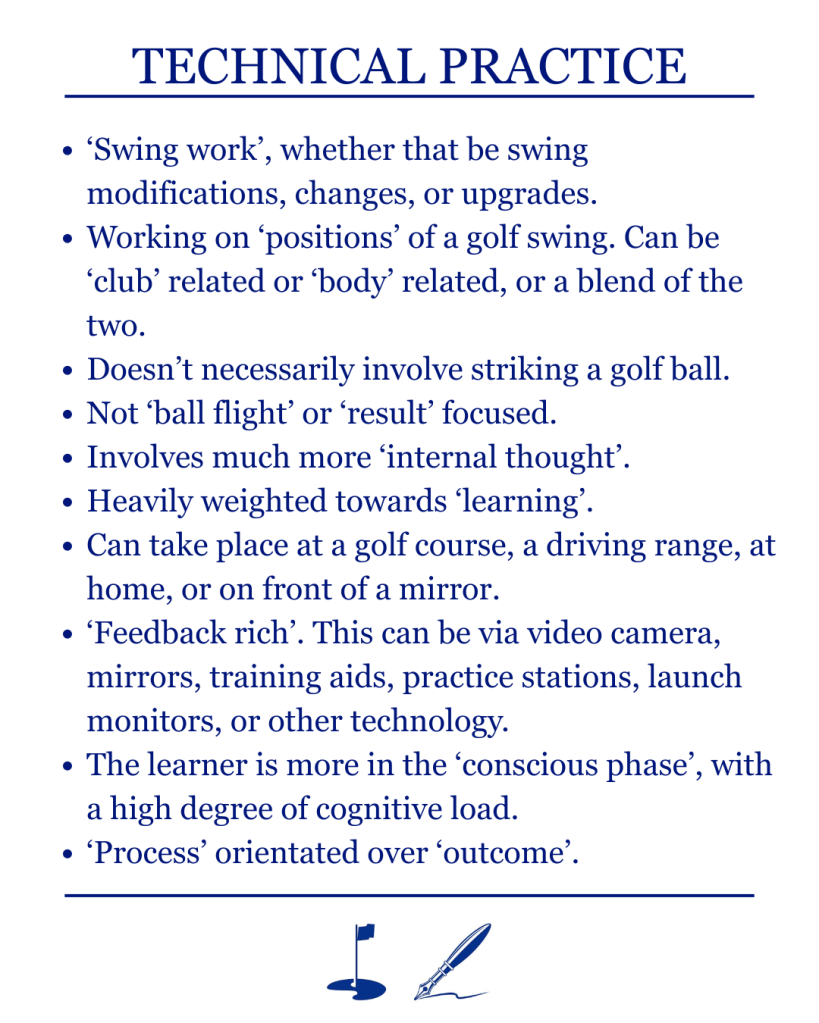
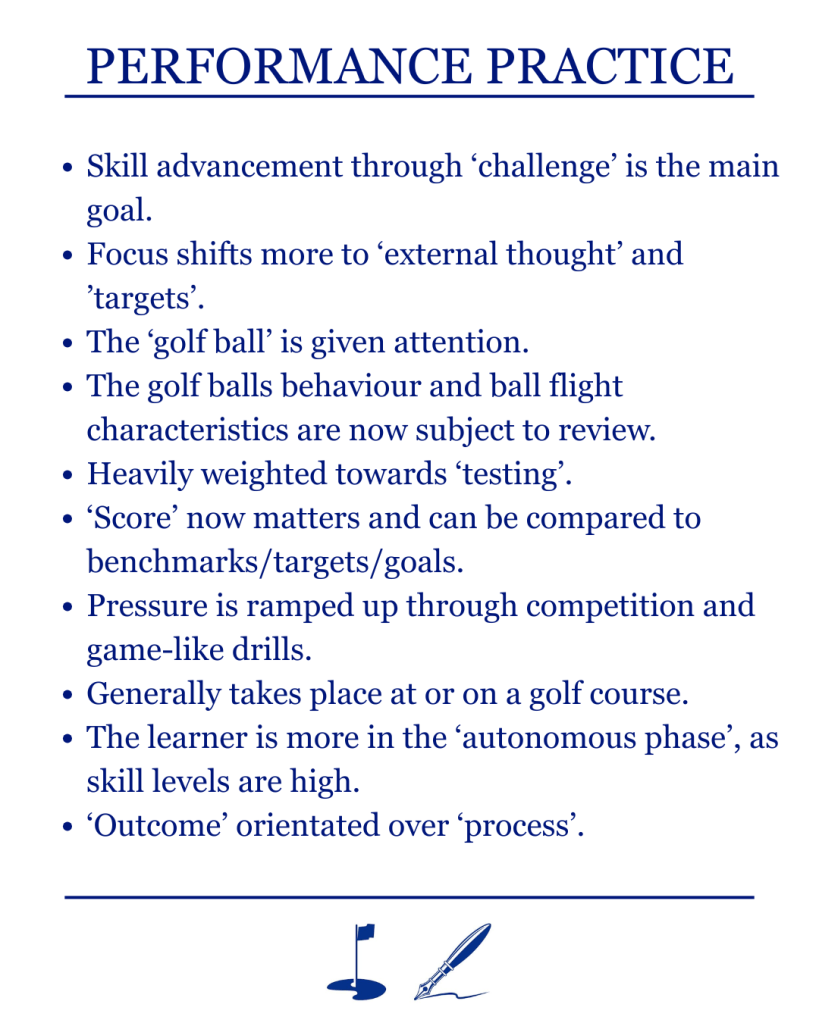
two categories of practice and examples
side notes
- Time frames can’t be put on how long someone remains in a ‘skill category’. This could be weeks, months, or years. This will largely depend on the available time the golfer has to dedicate to the game; their effort; their focus; their discipline; their accountability; their athleticism; and their ‘learning potential’. One golfer may graduate from novice, to advanced beginner, to intermediate, etc. in a much shorter period of time, compared to another who began the journey at the same time.
- Points are not set in stone. All levels of players can move across the graph. No one is immune to being positioned at any ‘point’. For example, an ‘expert’ may at some point be placed more towards the ‘performance’ side of the graph, and then at another stage of a calendar year be moved towards the ‘technique’ side.
- Sub-categories within the player’s game can be at different points of the graph. This includes both different departments of the game and different clubs within the bag. For example, a player might be working on the technique of their approach play, whilst working on the performance of their bunker shots. Or, a player might be working on their driver technique, whilst also working on their putter performance.
- Subjects like ‘swing changes’ can’t be rushed. Relating to the previous point, this is largely dependent on the individual and their characteristics. Some may embed the necessary change quicker than others. Unfortunately the timeframe for ‘change’ is not easy to predict. The timeframe and pacing of this change should be overseen and guided by a qualified coach or professional. It is the coach/professional’s job to prescribe the necessary ‘change’ and how it can be achieved.
- ‘Swing changes’, even though in a perfect world, would be carried out in the ‘off-season’ part of a year, may also be needed ‘in-season’. At times, it is much better for the golfer’s long-term progression to begin change immediately, rather than delaying the inevitable. Short-term and long-term objectives should be considered and weighed up in all decision-making.
- This is the same for ‘competition prep’. In a perfect world, the golfer would be much more performance-focused than technique-focused in this zone. However, in some scenarios, an injection of technical practice is needed when technique is holding the golfer back from being competitive.
- At no point on the graph do I believe someone should have their practice time weighted 100% towards performance, regardless of how ‘good’ they are. Even those at the top of their craft should ensure their technique is constantly monitored, maintained, and sharpened. If 100% of practice was ‘performance based’, the opportunity for ‘technique drift’ exists. Those fully ‘on top’ of their games, do not let this happen.
- Where a golfer is placed on the graph, at any point of time, must be lead and directed by a qualified coach or professional. It’s imperative for a golfer’s progress that they are led by someone who knows ‘what it takes’ to move through every skill level, and then where to weight their practice time at the present moment. This will speed up the progress of the golfer, and ultimately increase their potential in the game.
 Golf Thoughts