
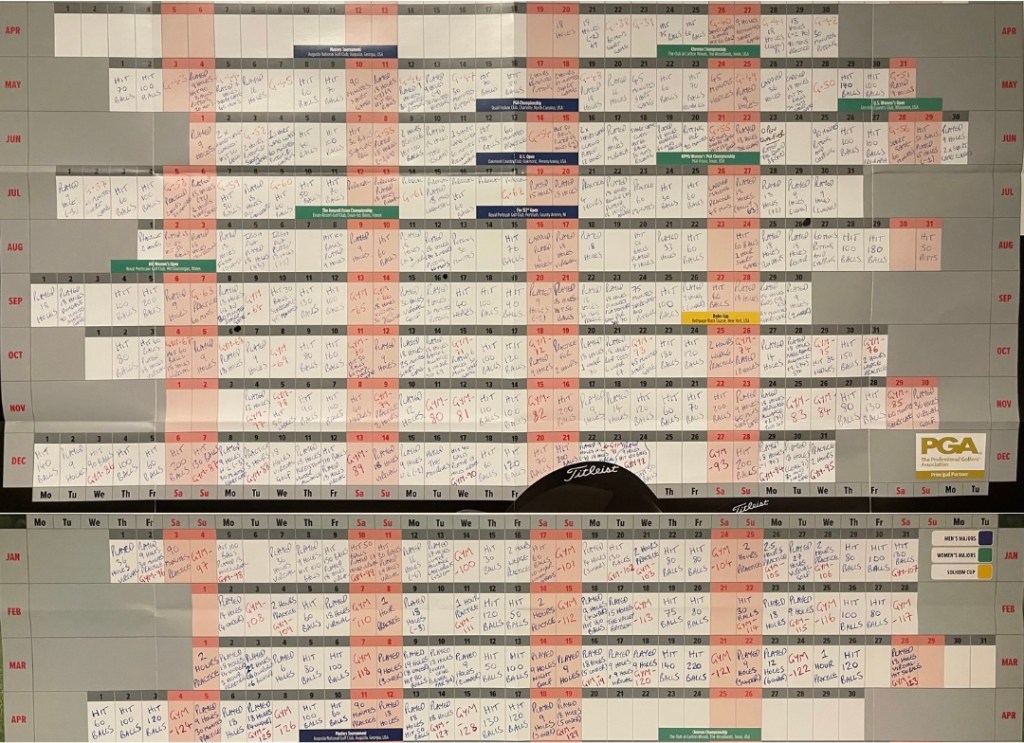
I recently just passed the one-year mark of my ‘wall chart’, which anyone that follows me will be aware of.
When I began filling in my wall chart on the 20th April 2025, I had no intention or thought that I would continue it for a full year. The original purpose was to fill it in for the weeks leading up to my Open Qualifier on 23rd June, as I wanted evidence written down, that I had at the very least made an effort to prepare for the event.
Once the 65 days and qualifier day had passed, I then decided to keep it going for my next tournament at the beginning of August. When that passed, I decided to continue until the end of the main golf season, 30th September. Then, until the end of 2025. And then, ultimately, I thought I was that close to a full year, that I may as well complete the 365 days.
There are so many learning points from the last 365 days, that I don’t think I could do it justice by a quick summary in a limited number of characters. For that reason, I’m simply going to write.
I have written previous posts on my thoughts on milestones throughout the journey. I wrote my ‘Road to The Open’ post after 65 days; my ‘2025 Wall Chart’ post on the 1st October after the ‘main golf season’; and my two ‘7 Months’ posts on 1st and 16th December. Everything written in these posts describes what was in my mind at that very moment in time.
As each week and month passed, my views and learning points grew stronger, developed, and at times, changed. A positive of passing time and ‘experience’ is that we can hopefully figure out what works, what doesn’t work, and we can be more confident in our conclusions. These conclusions get sharper and more honed with experience. Time allows us to gradually ‘filter’ out what we believe doesn’t work and results in more precise ‘search results’.
For this reason, I have purposely not re-read what I have written in my previous posts. I want my ‘1 year writing’ to be solely about what my views are right now as I write. There may end up being crossovers or overlap in sections or themes of the writing. If so, that strengthens the points even more, as I clearly feel that they are important enough points to repeat.
What started out as a few weeks’ tournament prep, ended up being a full year of research. I’ve learnt about myself as a golfer, as a coach, and as a person.
I hope my findings can be of interest or use to others out there. And who knows, maybe they might even motivate someone to begin their own version of the ‘wall chart’.
Please find my current thoughts in the writing below.
Enjoy.
- The glue that holds a commitment like this together is your ‘reason’ for doing it. If that reason is strong, you will not give up, especially in the long run. Reason leads to purpose, which incentivises commitment.
- My original reason was to improve my golf, as I wasn’t happy with where my game was at. So, the underlying reason was ‘pride’. I take pride in my golf and wasn’t willing to accept mediocrity.
- You have to find your own ‘reason’. No one else can figure it out for you. If the reason comes from within, it strengthens your bond with the commitment and journey. Do it for you.
- Create both short-term and long-term goals in the journey. These can be constantly evolving. The goal posts can be moved further away as you achieve each goal. This ensures focus and progress are always present.
- It doesn’t take that long for a habit and routine to develop. After 2–3 weeks of doing something, it becomes routine. After 4–6 weeks, it’s a habit. After 3–6 months, you don’t give it a second thought, you just do it. It’s autopilot.
- It certainly helps if you ‘enjoy’ the habit and routine. If you find it difficult, boring, or hard work, it’s very easy for someone to give up. On the other hand, if you love, enjoy, and feel good carrying out the habit and routine, it doesn’t feel like ‘work’ or a ‘chore’. So, my advice is to find something you have a legitimate interest, joy, and passion in. You’ll stick with it far longer.
- There’s so much to be said for ‘just showing up’. The statements ‘don’t put up a zero’ and ‘never miss twice’ always stick with me. This means even practising for 15 minutes a day is better than not practising at all. All these sessions, no matter how small, add up over time. The disciplined people also ensure they don’t miss multiple practice or training days in a row. It’s OK to miss the odd day, but don’t let this become a regular occurrence. If you miss a day, for whatever reason, get straight back on track the next day. This leads back to the creating habits point.
- Remember progress isn’t always linear. The rate at which you progress may completely differ from another. You will have good days and bad days. Your progression may stall, and stall for a while. I believe this can simply be a gentle reminder to double-check you’re carrying out the necessary work and reps, to then hopefully move back into the progression phase.
- Self-reflection and reviews are such an important facet of avoiding stalls in progression. Weekly or monthly self-appraisals of work carried out, can help refine the work needed for the desired results. If your results are poor, ask ‘why’. If your results are good, find out ‘why’. These answers can only be found if deep, honest reflections are carried out, covering all details of the ‘work’.
- Even when, at times, you feel you have everything under control, a bump in the road can appear from nowhere. Don’t let these moments deter you. Just accept that they’re unavoidable in volatile crafts like sports. The best simply ride out the storm and have trust that their understanding, experience, and skill set will see them out the other side.
- At the same time, you will have great weeks and periods of performance. If you are working on the correct things, of course, you should see results at some point. My advice is to really enjoy these periods of time, as the one thing guaranteed is that they will, unfortunately, not last forever. For golf, write down your thoughts at this time, video your golf swing, and figure out ‘why’ you’re having success. It’s vital to have this information to look back on when you hit the ‘bumps in the road’.
- When you get to a certain milestone timeframe in the journey, you will always look back at a previous milestone thinking about how little you had done. For example, after 65 days of prep for my Open Qualifier, I thought I had done adequate prep and work. It’s only when I got through 6 months of ‘work’ that I realised how little 65 days of work was. The same goes for the 1-year milestone. I now look back at the 6-month milestone and think I did nothing in relative terms. I would imagine this could be extrapolated out on an infinite scale. Meaning after 2 years, 1 year feels like nothing. After 5 years, 2 years feel like nothing. After 10 years, 5 years feel like nothing. Etc, etc.
- This isn’t to downplay weeks or months of solid work, but more to make the point that, in my opinion, if you really want to prep for a tournament or important life event, it’s a minimum of 6 months’ work to see proper change. 1 month of practice or work is of course good, but in the grand scheme of things, it’s only a drop in the ocean. So, the learning point is to begin your preparation far earlier than you think is needed.
- Writing things down is the best form of accountability. You can’t lie to yourself when writing things down on paper or a form of technology. I look back at everything I’ve written down for the last year, and it provides evidence that I held myself accountable. I don’t need to lie to anyone, as I can simply show them my wall chart. With each day filled in, I learnt a bit more, processed my thoughts a bit more, and maybe most importantly, gave myself peace of mind that I was at very worst ‘trying’ to get better.
- Evidence builds confidence. I am far more confident and have much more peace of mind, standing on the first tee, knowing I have at least put in the work. I’m not feeling anxious because of a lack of preparation. I can accept nerves because of the situation, but I can’t accept nerves stemming from the guilt of poor preparation.
- There is no more powerful evidence than ‘results’. In golf, this means a great score or result in a competition or tournament. This type of evidence should lead to the highest levels of self-confidence, as you now know you can perform on the main stage.
- Golf, like I’m sure many other crafts in life, will frustrate people, as nothing is guaranteed. Those that often feel the hardest done by in golf are those that believe they have put in the necessary work, but aren’t getting an equal return in results.
- I’ve always said that golf doesn’t follow the ‘deserved’ story line. If this was the case, the hardest workers would simply win every week, as they would ‘deserve’ to win. Somebody can work their proverbial ass off, and still come in with a poor result. We just have to trust, that in the long run, if we’re putting in the correct amount of focused work, the results will turn in our favour. Unfortunately, there is no timeframe on this. This could be after 1 month, 6 months, or 2 years. We have to sign up for the long-run and know the tide will at some point turn in our favour. Patience and trust are needed.
- This leads to the ‘quality’ of practice. Having hit thousands upon thousands of golf balls over the last year, I know what it’s like to have a high ‘quantity’ of work put in. Even though this may lead to some progress and results, I believe we should also be judging the quality of our practice. The perfect mix is a ‘high quantity, of high quality’.
- Don’t be the person that judges their practice purely on time or work load. If working on the incorrect things, we could actually digress our technique and/or skill. Ensure you are working on the correct things to improve (ideally prescribed by a qualified professional), and are then doing an adequate quantity of this to see or make change.
- I’m still trying to decide whether I would rate quantity or quality higher on the importance ladder. On one hand, there could be a player hitting 500 balls per week, further ingraining a bad tendency, and on the other hand, there could be a golfer hitting 50 balls per week, working on evidence-based movements that should make them better. The first golfer will no doubt hit a brick wall in terms of development at some point. The second golfer will take a very long time to see ingrained change, as their weekly ball count is so low. The pressure on a golfer, who truly wants to see change, and see change within a somewhat reasonable timeframe, is that they need to ensure the quality of every practice session is at an extremely high level, and they need to be carrying out these types of sessions, ideally a minimum of 2 or 3 times per week. There are no shortcuts to getting better.
- Expectations of the ‘practising golfer’ need to be realistic. If a golfer’s practice is of poor quality, they should not expect to reach much higher levels of performance. If a golfer’s practice is of very low quantity, they should not expect fast results. This is why it’s so important to be totally honest when reviewing both the quality and quantity of our practice.
- It may seem obvious, but there really are no shortcuts or secrets to improvement. Time and effort have to be put into anything in life. No one is born an expert in their craft. This must be developed and built over a period of time, generally a long period of time. So, if you want to see improvement in anything in life, be fully prepared to put in the work and time. Unfortunately, regardless of what some might say, no one is exempt from this. The sooner anyone realises this, the better, and the sooner the desired results will appear.
- Why time is such an important feature of any development process, is that it takes a lot of time to refine and mould a blueprint for success. It’s taken me the guts of a year to figure out what works for me, what doesn’t work for me, what gives me the opportunity to play my best, and what a typical practice and play week should look like. I know what departments of my game need more attention than others and what I simply cannot ignore throughout the course of a preparation phase. This has been fine-tuned and researched through months upon months of work. I’ve ‘filtered’ out what doesn’t work for me and my ‘search results’ are very specific to what I need. Again, there is no fast-track answer to this. This can only be figured out through a huge number of reps and experimenting.
- The disclaimer to the previous point is that I’m not suggesting I have fully figured out my ‘perfect recipe’. That will take years to figure out, and should probably never take the form of a ‘final draft’. I’m simply a bit closer to figuring out my recipe compared to one year ago.
- Train your mind as much as you train your body. The ‘mental’ needs as much refinement as the ‘physical’ to reach the upper echelons of most crafts or industries. What’s in between the ears, especially in golf, can often separate one golfer from the rest, in both a good and bad way. We’ve all come across a person with a great swing that can hit all the shots, but their mind and ‘reactions’ hold them back. Without full inner belief and self-confidence, I don’t believe a human will reach the highest levels of performance. ‘Under the gun’ you need to back yourself. At times, we have to ‘see it’ before we can ‘do it’. ‘Focused’, ‘calm’, and ‘clinical’ are words that I associate with a great mind.
- Don’t ignore the ‘physical’. By this I mean getting stronger, fitter, and faster. In the modern game, especially as the level gets higher, distance is imperative. If you don’t ‘bomb it’, you’ll be left behind. Extra distance will help all golfers, so fitness and gym work away from the golf course should be part of the weekly practice plan. Improved physical wellbeing and health can only help longevity, injury prevention, stamina levels, and mental sharpness coming down the stretch of a competition. Professional golfers are now ‘athletes’.
- Find your ‘superpower’ in golf. By this, I mean working out what area of your golf bag, when on song, results in your most consistent scores. This may be the driver, your mid-irons, your wedges, or your putter. Once you figure out what department of your golf bag dictates your scores the most, it’s your job to ensure this remains a superpower. Keep it sharp and try your best to have consistently high trust and confidence levels in it. Generally, when this area of the bag or particular club is on form, confidence trickles throughout your bag. For me, this is my driver. If I drive the ball well, I feel like I will always stand a chance of scoring. It’s always high on my ‘attention scale’.
- The one thing I can nearly, and I highlight ‘nearly’, guarantee, is that if you put in proper focused work and time into anything in life, you should 100% see progress and growth. I just can’t see how anyone could not get better if the time and quality of work is present. This is even more reason to bite the bullet and commit to something. I can’t put an exact timeframe on when you will see that moment of change, especially in a volatile sport like golf, but you will see improvement. I can wholeheartedly guarantee I am a better golfer than I was one year ago.
- Results can simply be a result of just ‘not giving up’. If you stick at something long enough, with dogged determination, you will more than likely eventually achieve the result you desire. Most people just don’t stick at things long enough. The challenge in this scenario is continuing your focused work and reps, with the unknown timeframe of when you might reach your destination. So, continue to ‘stick at it’, even when those around you, or even yourself, might have doubts. The breakthrough could come tomorrow.
- Chase excellence in your craft or journey. I see no point in half-assing anything. To achieve the highest levels of performance, set your standards high and give all your effort. This means chasing every day with the same level of maximum effort. Don’t ‘go through the motions’ and at a later stage think ‘what if’. Leave everything on the table.
- If someone was to ask me if this level of dedication and sacrifice is worth it, I would have no hesitation in saying yes. Maybe that’s because I don’t see it as sacrifice. I love practising, playing, and trying to better my golf. But I do agree, the person has to ask themselves what they want out of the journey, and how much they truly care about the journey they are about to commence on.
- The more I think about it, the more I believe there is no such thing as ‘balance’ in life. In this day and age, it seems like everyone wants balance. If someone wants to be great at anything in life, whether that be a sport, their job, or raising children, the ‘balance’ has to be tipped towards that area of life. If they love what they’re doing, then at no point would they be worried about ‘balance issues’ in their life. They are following their passion and what makes them feel alive. There just aren’t enough hours in the week to have a perfect harmonious balance in all areas of life. I guess the main question we should all ask ourselves is what part of our lives we would like to tip the balance towards.
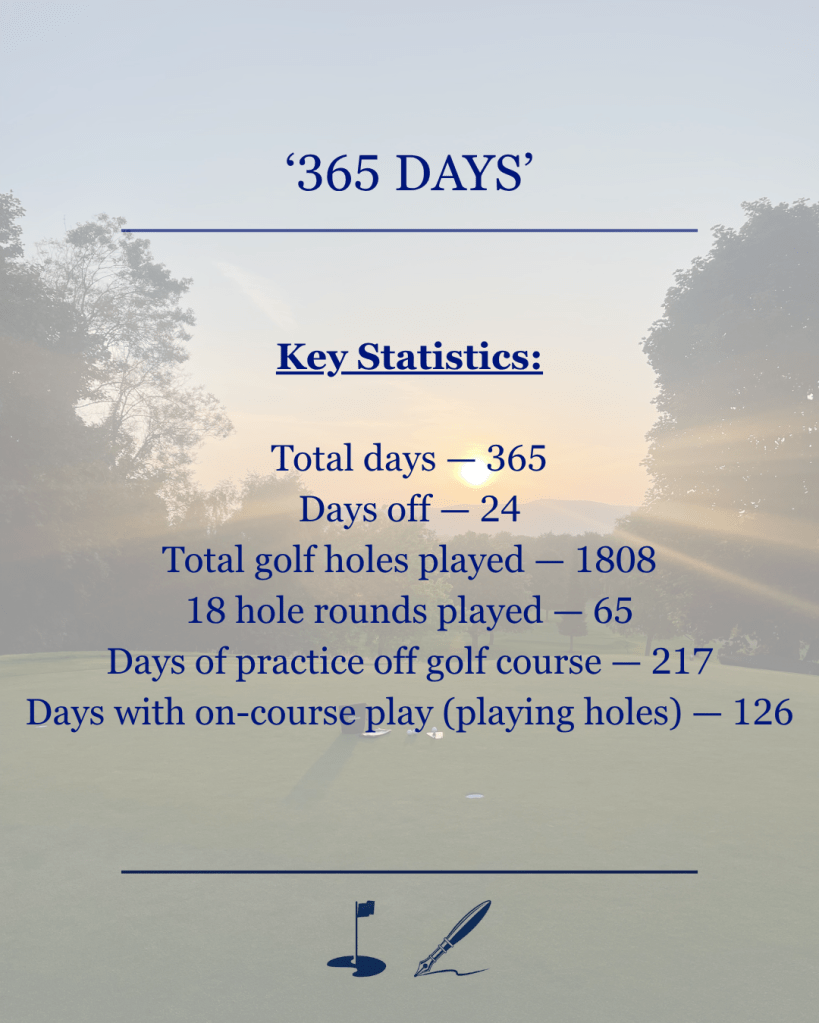
- Having carried out 365 days of work, with not very many days off, I can confirm you will be tired. The challenge with carrying out the year of work that I have, is fitting it in around a full-time job. My practice time involved a lot of late nights. If someone has a busy job and family life, I’m not sure if this level of commitment is achievable for many. If you do attempt the ‘no days off’ motto, just be prepared to feel tired and exhausted at times. I fully understand rest and recovery is extremely important, but I would personally rather be tired, knowing I’ve practised or trained hard, than well rested and done less practice or play. I’ve decided that preparation gives me more peace of mind than rest. That’s a decision I have made for myself, but I know one that might not be correct for everyone. I would imagine the secret is finding out how to put in the necessary work to feel like you can really improve, while also getting plenty of rest and recovery. A question easier answered on paper than in practical life.
- I try to think about what qualities and characteristics have helped me the most throughout the past year. If I was to narrow it down to four key attributes, I would say discipline, focus, pride, and a desire for continued improvement.
- Discipline, because without this, it’s far too easy to say no to a practice day or gym session. Golf is generally an individual sport, where you don’t have anyone in your ear holding you accountable. You need to be disciplined on the days you feel tired or the days when you maybe have another option. I fully believe anyone that is ‘elite’ at anything, just stays on course for longer. They keep going even when they might not want to, as they know in the long run, it’s the correct thing to do. They’re disciplined to make the correct choices.
- Focus, because without this, the quality of work isn’t present. You have to be able to block out the noise and give your current task the full focus needed to succeed. This is more challenging in this day and age, with distractions everywhere. Put the phone away and focus on one thing at a time. Be fully immersed in your ‘work’.
- Pride, because this keeps you going. The world’s best take pride in the quality of work they produce and how they handle themselves at all times, even when faced with adversity. In golf, this may mean fighting until the end of a round of golf, to squeeze out every shot possible, even when ‘struggling’. My pride in my golf provided the catalyst for my one-year journey and ultimately kept it going, as I take pride in trying to be a good golfer.
- The desire for continued improvement is generally a quality found in most successful people (however you may define success). They don’t like standing still or getting stagnant. They’re hungry to keep developing and progressing their skill set. When they get better at one thing, they’re straight onto thinking about the next potential improvement. Excellence in a field is normally an accumulation of ‘not settling’.
- On a deeper level, throughout the course of a journey, or 365-day wall chart, you will find moments of peace and clarity. There will be moments, often on your own, in the middle of your ‘work’, when you feel at peace. It’s maybe something that has to be experienced to be understood, but there will be people out there who know what I’m talking about. Time seems to slow down, and you’re very present ‘in the moment’. A sense of calm will onset, and you simply feel content. It’s when you experience this that I believe you know you are on the right journey and doing the right thing for you.
- I’m still processing if the last 365 days went by fast or slowly. It definitely feels a lot longer than how it looks when I see it written down on the wall chart. I’m also processing whether I believe the last year is a large or small body of work. In the short term, it’s a large body of work, but in the long term, potentially a small body of work.
- It makes me think, if someone did this level of work for 5–20 years, how good could they get at their craft? I have no doubt that they will improve drastically and get to a much higher level than they began. To become a world leader in anything, I believe, and as most studies would show, this level of work would need to begin from a young age. Humans are increasing the standards and levels of performance in most sports year-on-year. Athletes, and specifically in golf, are entering the scene at younger ages. As technology and information moves forward each year, human potential seems to be improving. However, this potential will probably only be achieved if the human work ethic and desire are also fully present.
- I’ve thoroughly enjoyed the last 365 days. I’ve learnt far more than I probably would have thought. My understanding of golf as a whole has, of course, increased. My golf I.Q. is constantly on the rise. I’m a better golfer because of it. And, I’m a better coach because of it. As a coach, I always aim to lead from the front and by example. I wouldn’t make others put in this level of work unless I was willing to do it myself.
- Will I continue the wall chart? I’m still deciding. Would I recommend someone embarking on the same year-long journey? For some, yes. And, for some, no. You’d have to discuss the topic with me in person to delve deeper.
- I know it may be an overused statement in today’s world, but it’s one that I now know is correct, well for me anyway. ‘Trust and enjoy the process’. Of course, I have really enjoyed playing some great spells of golf over the last 12 months, but to an even higher level, I have honestly loved the daily task of trying to get a bit better, asking questions, pushing myself, and putting in the daily work. Partly because it never felt like work.
- I’ll always look back on my original ‘wall chart’ with fondness, as I had no idea what I was getting into. But I’m certainly glad I did.
- Onwards…..

